The week after Diwali, the same story walks into the clinic again and again.
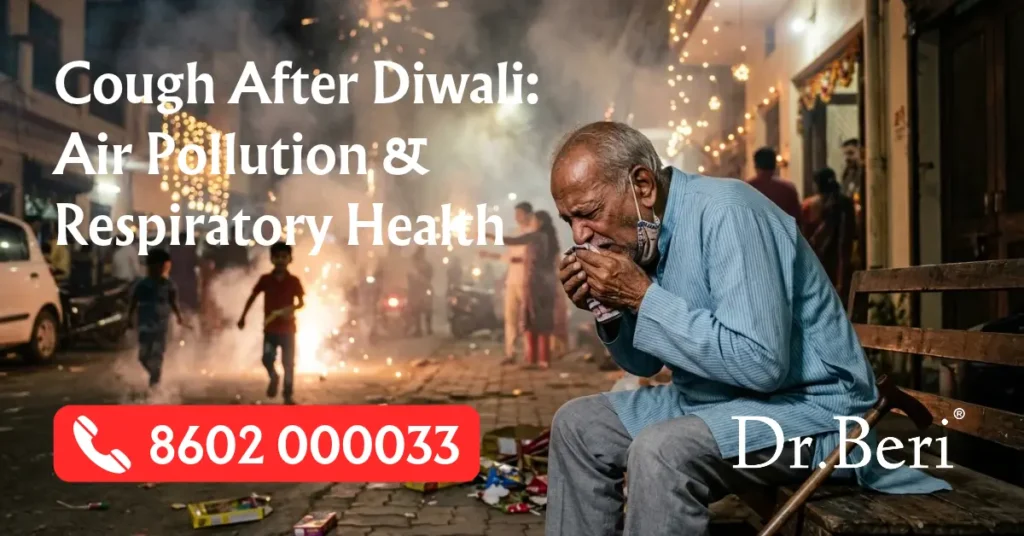
A cough after Diwali is often caused by firecracker smoke and seasonal air pollution irritating the throat and airways. It often shows up as a dry, scratchy cough with a burning throat and can take several days to a week to settle. See a doctor the same day if you have difficulty breathing, wheezing, chest pain, blue or greyish lips, or blood in the phlegm.
The story usually goes like this: “The festival was enjoyable, the house was full, the lights were pretty, now I have a dry cough and have had one for the last 4 to 5 days.” Smoke irritates the lining of the throat and airways, and a persistent, dry, tickly cough is the body’s reaction to that irritation. The details are explained below.
It can feel like a cold, but in many cases the airways are reacting to smoke from firecrackers and paddy stubble burning.
How firecracker smoke and air pollution cause a cough
Firecrackers are small pyrotechnic devices that burn chemical mixtures rapidly, producing a small explosion, smoke and gases. The smoke contains fine particles (PM2.5 and PM10), soot, gases such as sulphur dioxide and nitrogen oxides, and traces of metal salts used for colour. Fine particles like PM2.5 are small enough to travel deep into the airways.
Because the membranes lining the throat and windpipe are thin and sensitive, they easily become inflamed and swollen after coming into contact with smoke, which triggers the cough reflex. This irritation can linger for several days after the smoke has cleared, and sometimes longer in people with asthma or allergies.
For us in Punjab, there is another layer. Diwali usually falls in the same weeks as paddy stubble burning, and the cooler evening air keeps all this smoke close to the ground. So people who never lit a single cracker still end up coughing. That is why air pollution and cough often go up in Punjab during late October and November, and why it is worth checking your city’s AQI before stepping out. Children playing outside, elderly parents sitting on the terrace, a shopkeeper with the shutter open all day: everyone breathes the same air.
Symptoms of cough and throat irritation after Diwali
It usually comes as a combination. A dry, scratchy cough. A burning or itching throat, sometimes a hoarse voice. Red, watering eyes. A blocked or runny nose. A tightness in the chest, and a cough that gets worse at night or when you step into cold air. Some people notice they get out of breath on the stairs, which they did not before.
If this sounds like you, irritation from smoke is the most likely cause. That is different from an infection, and the approach is different too.
Breathing problems after Diwali: when to see a doctor
Please see a doctor the same day, or go to a hospital, if there is difficulty in breathing or wheezing, chest pain or pressure, blue or greyish lips, blood in the phlegm, or high fever with a congested chest. The same goes if you are asthmatic or have a heart condition and things are getting worse instead of better. In a small child, fast breathing, pulling in at the ribs, or being too breathless to feed or talk is an emergency, not something to try a home remedy for first.
Home care for a dry cough after Diwali
Most of it is plain common sense, and it works better than people expect.
Stay indoors when the air is at its worst (check your city’s AQI), usually early morning and after sunset, and keep the windows shut. Sip warm water through the day. Warm water with a little honey and ginger/tulsi is soothing to the throat. (Do not give honey to children under 1 year.) Some people find steam inhalation soothing once or twice a day, using plain hot water. Evidence for benefit is limited, and steam can cause scalds, so avoid it for young children and keep the water at a safe distance. Gargle with warm salt water. Keep your room free from incense, agarbatti, mosquito coils and room fresheners, because indoor smoke and fragrance can add to the irritation.
If cold drinks, ice cream or very oily and spicy food seem to trigger your cough, avoid them for 2-3 days. Rest your voice if it is hoarse. If you have to go out when smog is thick, use a well-fitted N95 mask. A simple cloth mask offers much less protection against fine particles.
Also Read: Home Remedies for Throat Pain and Infection
Homeopathy for cough after Diwali: how a remedy is chosen
A cough is not looked at as a single entity. In homeopathy, two people who inhaled the same smoke may be prescribed different medicines, depending on how the cough behaves in each person. Is it a dry or loose cough? Does it come in fits? Is it worse lying down or sitting up? Is it worse at night or after eating? What sets it off? Are there any other symptoms the person may have?
In traditional homeopathic practice, remedies that may be considered for a cough after Diwali include:
- Drosera: dry cough that comes in fits and is worse lying down at night.
- Rumex crispus: dry cough set off by a tickle in the pit of the throat, worse in cold air.
- Phosphorus: cough set off by talking or laughing, worse in cold air.
- Spongia: dry, barking cough with a rough, dry throat.
- Bryonia: hard, dry cough with chest pain, where the person holds the chest while coughing.
- Arsenicum album: cough with restlessness and breathlessness (breathlessness needs medical assessment first), worse after midnight.
- Euphrasia: cough with red, watery eyes.
I am listing these so you can understand how the choice is made, not so you can pick one off the shelf. The right remedy, its potency and how often to repeat it depend on the whole picture, and a mismatched remedy is unlikely to help. If the cough lasts beyond a week, returns every year after Diwali, or comes on top of asthma or allergies, it is worth a proper consultation alongside your regular medical care. If it returns every year, a consultation can look at your wider pattern, such as seasonal triggers, allergies and past chest complaints, so you can plan before the next festival season.
How to reduce smoke exposure before and during Diwali
Fewer crackers, or none, is the honest answer. If the family does burst them, do it in an open space, stand upwind, and keep children and older people away from the smoke. If someone in the house has asthma or allergies, keep their regular medicines and any prescribed inhaler handy, and speak to their doctor before the festival, not after it starts.
Questions we are often asked
A mild irritation usually settles in a few days to a week once you are out of the smoke. If it goes past two weeks, turns wet with yellow or green phlegm, or comes with fever or breathlessness, get it examined.
It can be simple irritation, an allergic reaction, or a viral infection that took hold because the airways were already inflamed. The pattern of symptoms and how long they last help tell them apart.
Homeopathic medicines are commonly used for children, but the remedy and dose are best chosen by a qualified homeopath or doctor, and a child who is breathing fast or struggling to feed should see a paediatrician immediately.
Because the smoke does not stay where it was lit. Neighbourhood smoke and the general pollution of these weeks affect everyone who breathes it.
A dry, irritating cough and a wet, chesty one are handled differently, so it is better not to guess. If the cough is not settling, talk to your doctor.
Mild throat and airway irritation can be eased with the home care steps above, and you can also ask for a homeopathic consultation. True breathlessness, wheezing or chest pain needs urgent medical attention first.
Smoke and fine particles are recognised triggers for asthma symptoms. If you have asthma, follow your asthma action plan, keep your reliever inhaler handy and see your doctor if symptoms worsen.
Consult Dr. Beri
Dr. Beri | Dynamic Homeopathy has been treating families for over 30+ years, with clinics in Amritsar, Batala, Tarn Taran, Beas and Ludhiana. If your cough is not settling after Diwali, book a consultation at one of our clinics or online. We take your full symptom history before suggesting a remedy.
Book a consultation at DrBeri.com.
This blog is for general information and does not replace medical advice. If you have difficulty breathing, chest pain or any severe symptom, seek immediate medical care.

Consulting Homoeopathic Physician
Dr. Ranvir Beri is a third-generation homoeopathic physician and a graduate of Homoeopathic Medical College & Hospital, Chandigarh. He follows a classical, patient-centric homoeopathic approach focused on individualized case assessment and holistic healing.